As someone who has been doing photography for over 10 years, I did hit plateaus multiple times and know perfectly how frustrating it is. You can really loose all motivation if your photos aren’t improving for a while. Especially if you are an ADHD type like myself and want to constantly explore and learn. And I think my approach to photography is exactly what helped me to continue doing this.
If you are reader of my blog for some time (sorry about posting rarely), you know that I talk more about principles of photography as visual art, and I find it more important than technical stuff in photography. I think of volumes in composition, shapes, contrasts, light and so on, then I may look into gear but that’s only a supporting part of something more fundamental.
It’s a bit like playing it boring but safe. You max out fundamentals and then your photos get to look better and better without tricks. That’s said there is still a ton of room for me to learn and I’m far from ever feeling like I have deconstructed photography and have nothing to do here.
So every one of us feel like there is a moment when you keep creating the same photos / paintings / designs or any form of visual art. That may sometimes stretch over a long period of time, especially if that’s your work.
To avoid stagnation, I explore other mediums alongside photography. Sometimes I mix them into my photographic work, sometimes I explore them purely for their own sake. The goal is always to see what else I can achieve, to expand my visual thinking, and keep creativity flowing.
Instalations Experiments: Light, Drapery, and Mini Installations
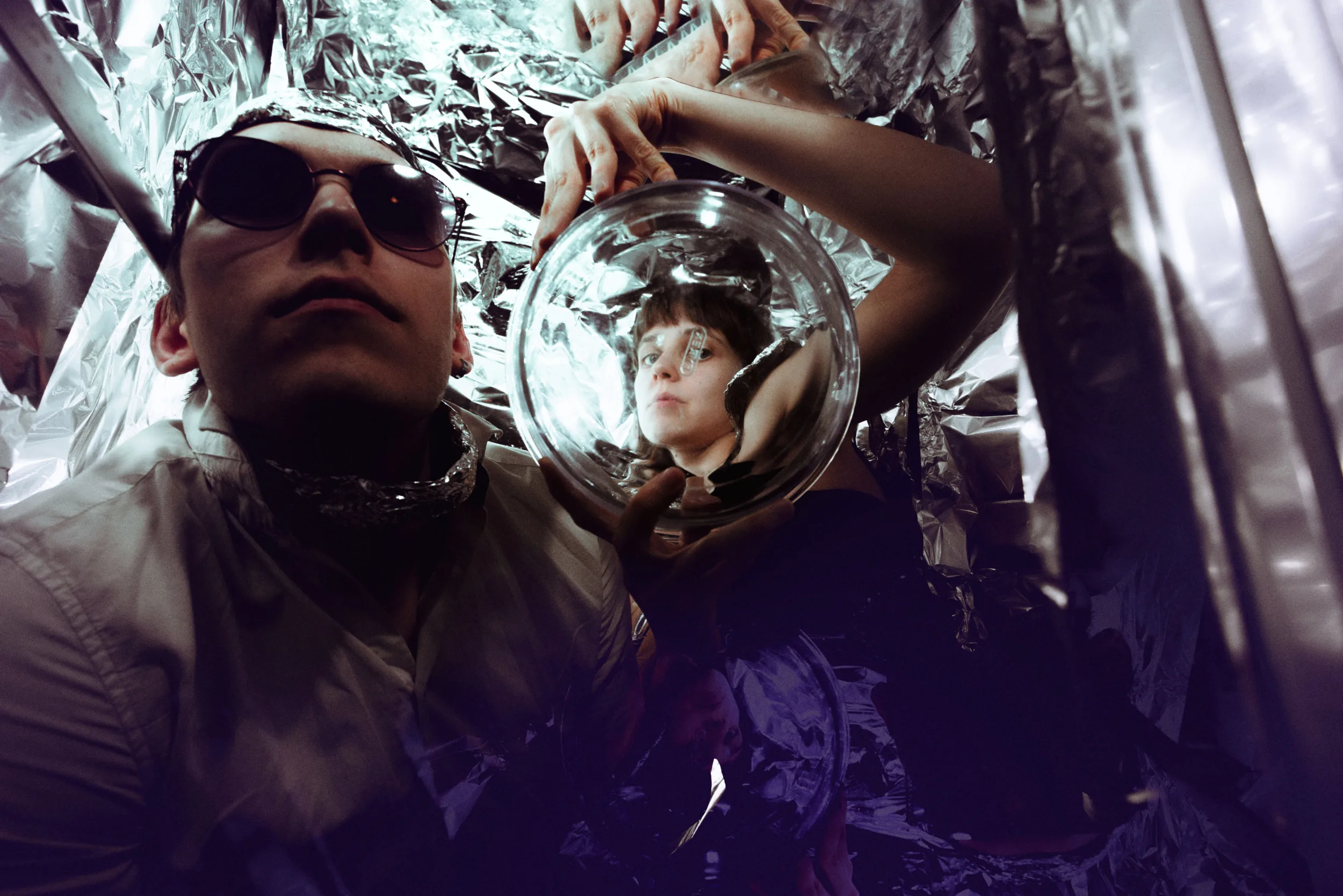
Even as a child, I was experimenting with visual composition. I’d use coloured paper, flowers, drapery, and whatever I could find at home.
I was trying to mix in some light in there, actually a very long time before I even thought about photography overall. And this is a sort of interesting thing. If I look at it back right now, that was an exploration of the scenery. And in my case, I do think a lot of the sceneries, like as compositions of the scenes in photography as well, thinking of decorating your room as scenes for photography is a fun thing to have your room looking beautiful, dynamic and potentially mysterious and also think of light and composition.
Fun thing, if you do that, you may as well in the end get inspired and take some photos with that setup.
At-home exercises you can try:
- Find a “frame” for small installations. Any part of your room where you can set the scene.
- Play with light using flashlights, use gels for coloured light, or simply desk lamps to create irregular light. That is to make more points of interest and composition within the “frame”.
- Move furniture or drapery to create unusual shapes or textures.
- Experiment with contour lighting—highlight shapes without showing full context.
- The goal is exploration and play, not perfection. Later, you can bring these lessons into portrait or scene photography.
Painting and Drawing: Foundations That Translate Directly
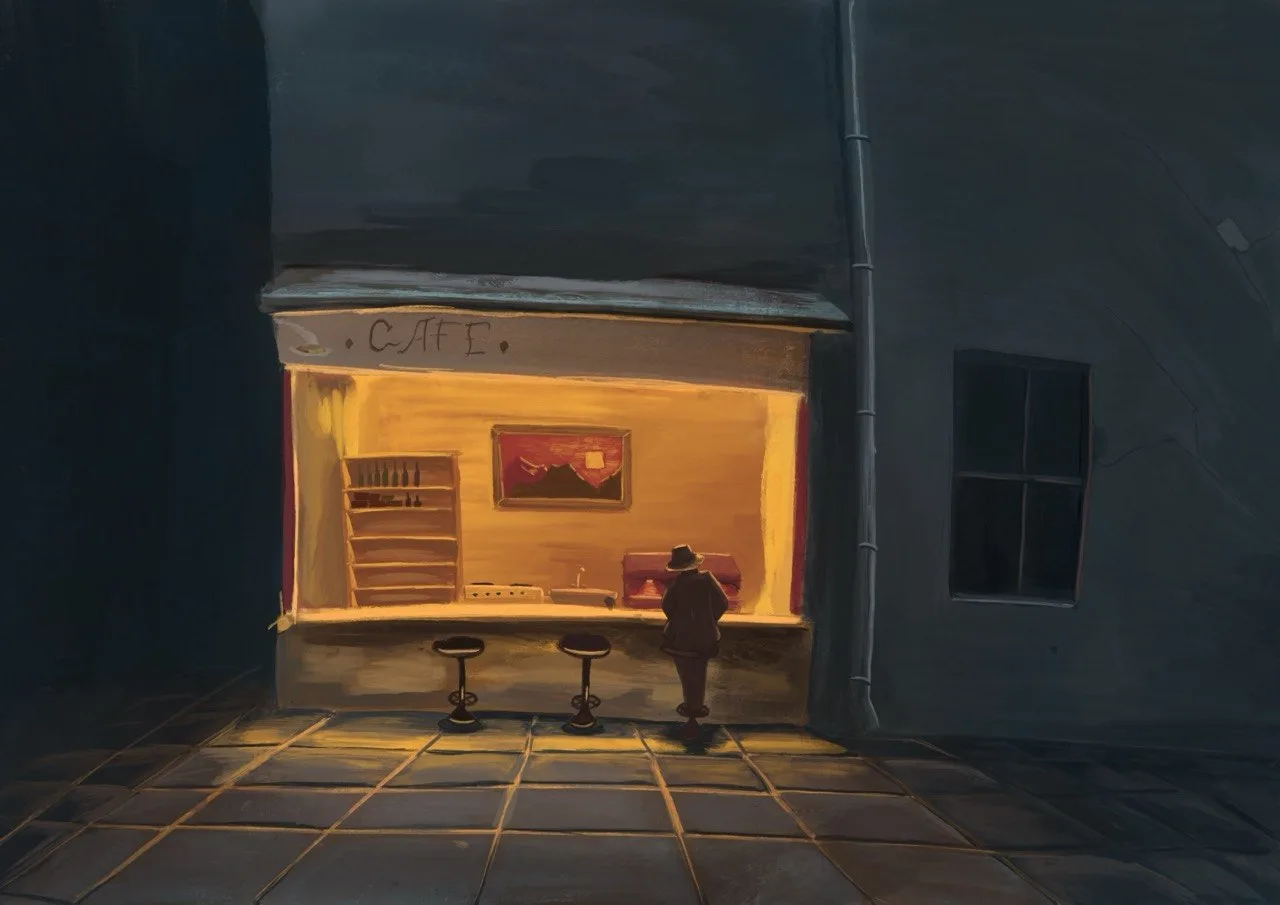
Painting and photography are deeply connected. Both are ways of interpreting visual narratives. Drawing and painting teach you the fundamentals of light, shadow, contrast, and composition. If you know how to paint or draw, photography becomes easier because the “eye” is already trained; you just need to learn the technical side.
I did painting since my teenage years. I started with drawing geometric shapes in art school before moving into painting, which is the right order. Similarly, in photography, I recommend starting with black-and-white work. It’s like drawing with a pencil: you focus on values, light, shape, and composition without getting distracted by colour.
Observations about colour and shadows:
- In painting, shadows are not just black—they are slightly darker, more saturated, and influenced by ambient light.
- In photography, colour values reflect light differently, and choosing the right palette can make or break the image.
- Studying paintings trains your eye to see subtle tonal relationships, which translates directly to photographic light, contrast, and colour.
How to apply this at home:
- Examine a painting and redraw it, copying values, composition, and colours. It doesn’t have to be beautiful—it’s a study.
- Create a colour palette based on the painting, matching tones as closely as possible.
- Repaint the artwork roughly, focusing on bigger shapes, values, and composition to understand why it works visually.
Even short exercises like this—copying a painting or making a palette—teach you to see colour, contrast, and composition, which you can apply immediately to photography.
As an example of what you can do at home, I’d say just open WikiArt—it’s full of paintings. If you’re not sure where to start, pick something that speaks to you. If you’ve done this before, of course, follow your own taste.
Start simple: maybe redraw a painting if you’ve never done it before. Focus on examining the composition—where the key points are, how the shapes interact. Try to mimic the values as closely as possible: the exact darkness of shadows, the brightness of highlights. You don’t have to make it beautiful—it’s more of a study than a finished artwork. By copying someone else’s work, you’re training your eye, and these lessons will stay in your brain to use intuitively later.
If you already paint or want to dive into it, try this: take an artwork and, on a blank piece of paper, create a colour palette from it. Match the colours as closely as you can. Even just doing the palette exercise helps—your perception of colour improves as you examine and find exact tones.
To take it further, you can repaint the whole artwork. Start with the bigger shapes, then gradually add details. Focus on mapping colours with their values and following the composition. The point isn’t perfection, but to understand why the artwork looks the way it does and why it’s visually pleasing.
These exercises translate directly into photography. You’ll naturally understand composition, light, contrast, and colour in a way that strengthens your photographic work immediately.
Collage Art: Composition and Colour Exploration
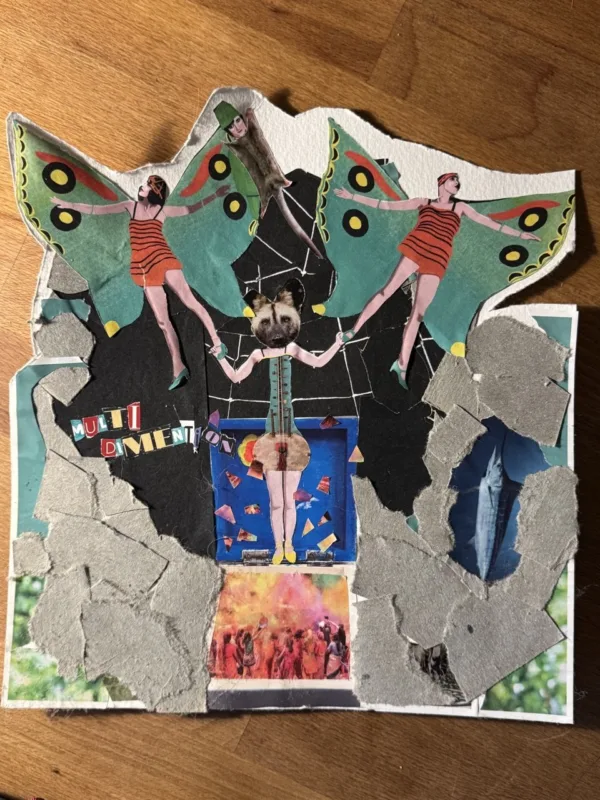
Collage is a simple, fast way to explore composition and colour without needing advanced tools. Collect photographs, magazine cutouts, coloured paper, or words and arrange them into a composition.
So here again, we come back to color palettes, because ideally, if you have enough materials, you want to select a somewhat restricted palette. For example, maybe you have some red paper and a photograph with red as the main color, and then the rest could be black and white. Suddenly, your main colors are just black, white, and red.
This process forces a kind of decision-making about what you already have in your hands and how you place it on the paper. It also trains you to be selective with colors, contrast, and composition, just in a slightly different way than photography.
As you progress in collage art, you start thinking about arranging compositions with a focus point, like using the rule of thirds. Later, you can experiment with more complex shapes, multiple focus points, and the overall flow of the composition.
The great thing is, it’s also fun and low-effort—you don’t need hours for it. Even a 30-minute evening experiment at home can be creatively stimulating.
Take in mind, collage art is a bit like photography, but without time pressure and usually more flat and graphic. It can be sort of a deconstructed style of photography where shapes play even bigger role!
- The challenge is making it coherent. Limiting your colour palette helps maintain focus.
- You can play with focal points, thirds, and visual flow—just like in photography.
- It’s a low-pressure, fun exercise that teaches composition, colour selection, and visual decision-making.
Tips for collage practice:
- Limit your palette: for example, use red, black, and white for cohesion.
- Play with layering and placement to guide the viewer’s eye.
- Try it as a 30-minute experiment at home—you’ll notice improvements in your photographic style.
Linocut: Black and white medium That Teaches You To Plan Ahead
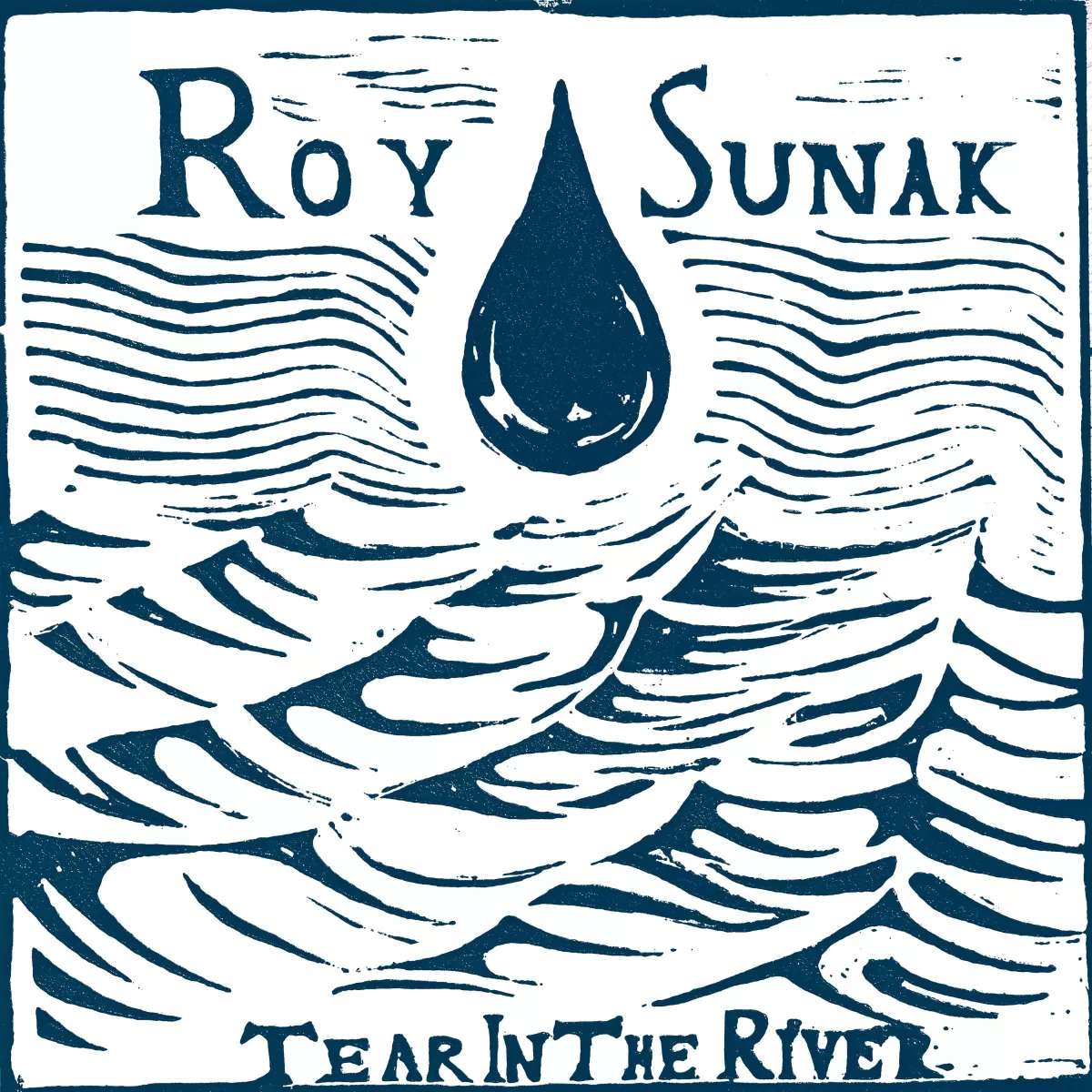
Above is a prototype of an album cover I did for my friend. In the end we have chosen a design made with my photographs but I wanted to throw in some more ideas.
Linocut is an interesting style of visual art at it makes you plan your composition carefully as once you cut out a piece of material, you can’t really fix that, and working with this medium you have to simplify shapes and then arrange them into a composition. At the same time it can be a fun and enjoyable process. something to pick up into photography for sure.
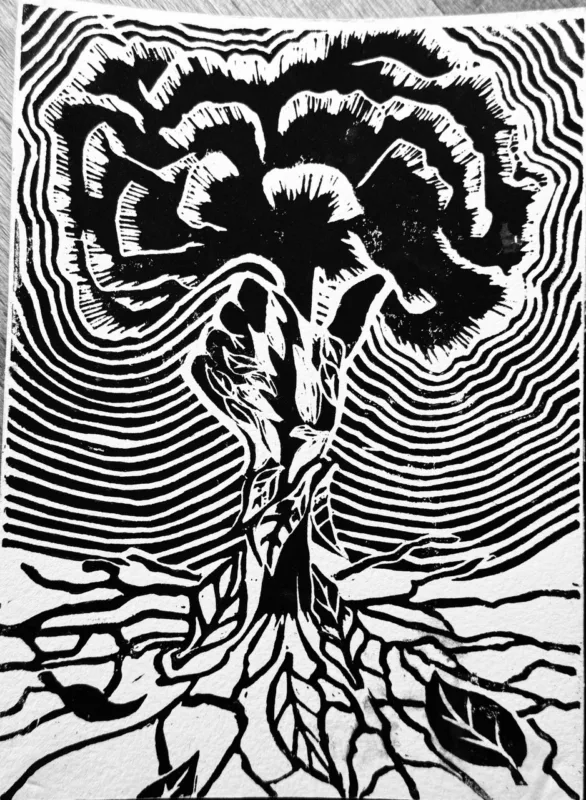
3D Modeling: Building Scenes and Exploring Light
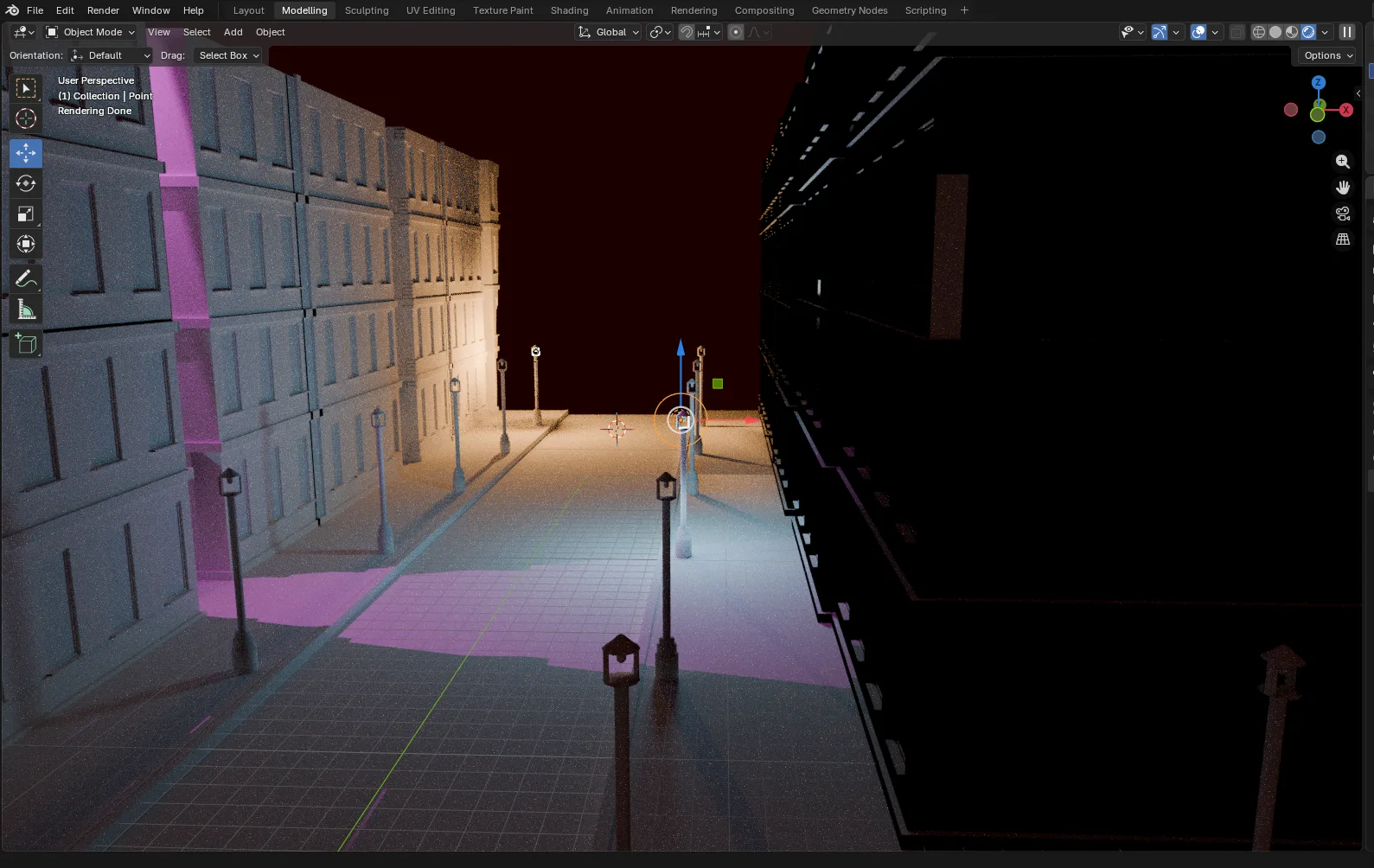
3D modeling is a medium that translates strongly into photography. It allows you to experiment with space, perspective, and light without limitations of the physical world. This is a little bit similar to making small installations at home. Certainly it’s a great way to explore creating anything—surreal or real. There are websites where you can download free basic assets, especially if you’re doing this as a personal project and not for money and want to avoid a plateau in photography, 3D art can give you some fresh inspiration and a feel for what’s possible. Sometimes you don’t even need to do much modelling, instead you can download assets available for personal use and have it as a playground.
The skills you gain translate a lot into photography. Even if you don’t have materials or don’t want to spend money, you can download Blender, watch some basic YouTube tutorials, and get started relatively quickly. Mixed with Photoshop, this opens up another creative avenue for photography. For example, you could place a scene with a person on a street and make the street dissolve into an endless, dark cosmos. Photoshop alone can do a lot, but 3D modeling gives you more control over the elements in the scene.
Once you learn the basics—which might take a few weeks—you can turn a photograph of a building into a 3D model. With several evenings of work, you could even model an entire street. From there, you can manipulate lights however you want:
- Regular street lamp top-down lighting
- Unrealistically bright lights from windows, like huge projectors illuminating the whole street
- Smoke or fog drifting through the scene
- Even floating the entire street in space
- You can change sizes of buildings to make the most plausible composition
It’s a creative exploration of another medium, and it feeds directly back into photography, because photography is, at its core, about working with light and composition. You can also create full sceneries and then Photoshop people into them, blending your 3D work with real photography in exciting ways. (fun thing, blender has the camera mode where you can choose focus point and focal length)
If you want to try it out here you can find some textures and assets (it’s not affiliate, it’s a public library!) : https://polyhaven.com/
- You can use Blender or similar software to build realistic or surreal scenes.
- Free assets and tutorials make basic modeling accessible.
- You can combine 3D scenes with Photoshop to integrate photographed subjects or experiment with surreal environments.
Creative exercises:
- Model a street or room and experiment with lighting: street lamps, exaggerated window light, fog, or cosmic light.
- Place elements in unusual ways to explore composition and perspective.
- Think of how light interacts with shapes; this trains your photographic eye for lighting setups.
Even if you can only dedicate a few evenings, you’ll develop intuition for scene construction, spatial awareness, and lighting—all directly relevant to photography.
Simplified 3D in Minecraft
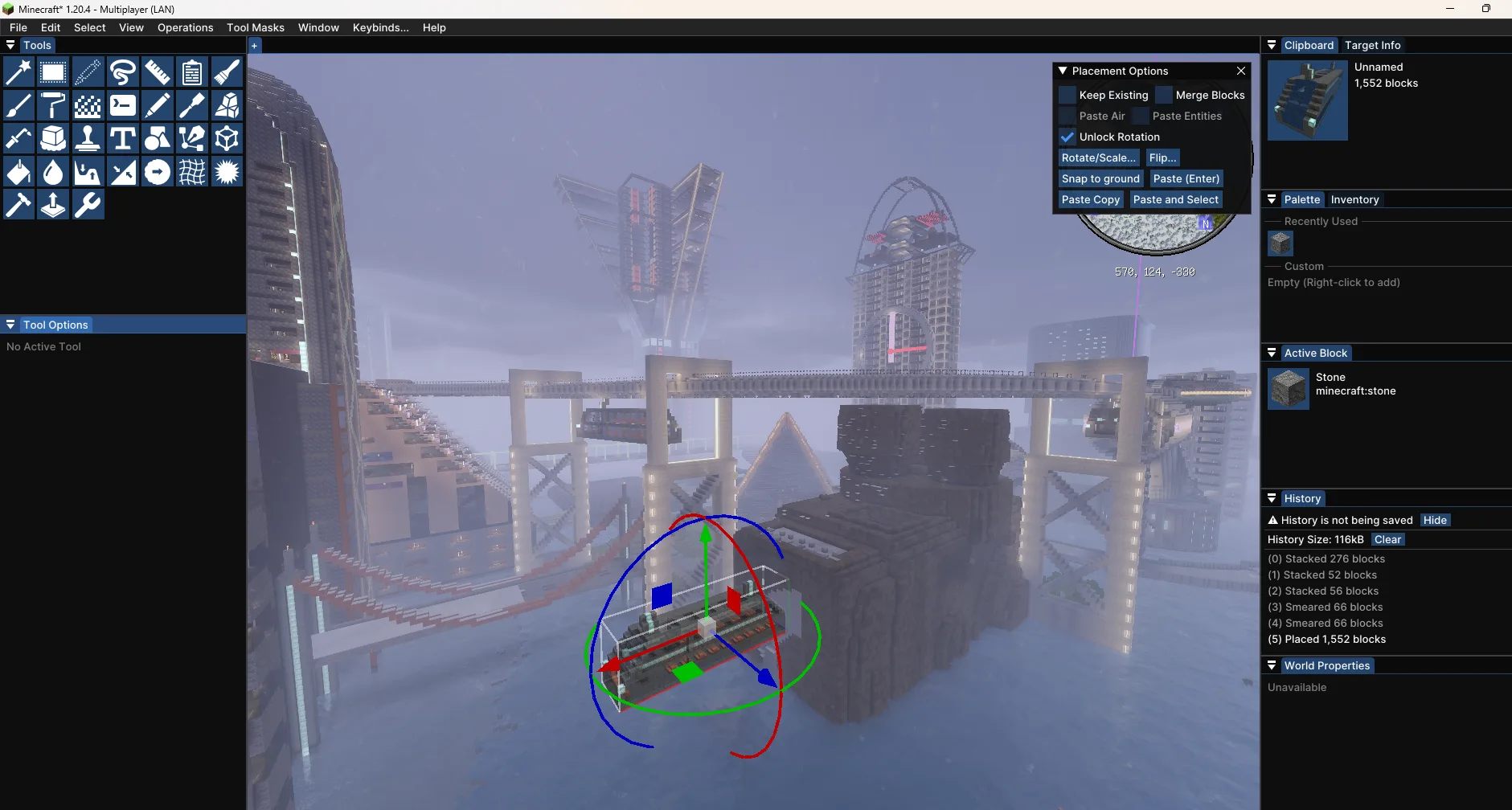
If Blender feels too heavy, Minecraft (with mods like Axiom) is an accessible alternative. You still need to learn how it works but its way simpler, yet with limitations.
It may sound funny at first! But read this one through too! In Minecraft you can work in 3D, and decide on light, colour grading, and composition, which makes it surprisingly close to real 3D modeling. You can even start with an empty flat world, which acts like a blank canvas, and then sculpt anything on it.
For people who want something simpler than Blender—which takes quite a lot of time to learn, and sometimes you just don’t feel like it after work, especially if you’ve already spent years learning Photoshop and Lightroom—Minecraft with the right mods gives you roughly the same experience, but everything is made out of blocks. The mod called Axiom lets you use almost the same controls and modeling tools as professional 3D software. The only thing you can’t really do without diving deep is creating your own textures, but most people don’t need to anyway.
At the same time, you can place objects anywhere, twist, pull, smooth, extrude—basically sculpt or shape things almost like drawing. It’s really similar to 3D modeling, but without learning nodes, texture roughness, or all the technical stuff. You still get to play with light, composition, colour, and shapes, just in a simpler, more approachable way.
- You can model scenes using blocks, twist, extrude, and sculpt shapes.
- Lighting and shaders allow creative control similar to professional 3D software.
- The blocky aesthetic still teaches perspective, composition, and scene planning.
- You can literally colour grade textures and colours and intensity of light, air density and so on!
- You can choose you field of view aka focal length.
- You can export it to blender as a 3d object, if you will want to make it more complex
AI: Inspiration(maybe), Not Skill (certainly)
Now, about AI. I don’t see it as a creative tool that can replace photography. You can use it to explore ideas, to get an approximate view of what you imagine, but it won’t make you learn the process. It’s more like hiring a freelancer: you tell it what you want, and it gives you something ready in a few seconds. If we replace AI with you personal human painting assistant, and you’d outline in detail concepts that you want to create to that person and the person will hand you ready visuals similar to what you asked for – that human assistant would learn way more than you about the visual style in the process of creation.
That’s fine for inspiration, but it’s not the same as going through the creative process yourself.
If your idea is intricate – more than just a detailed picture in a certain style, colour, or atmosphere – AI will struggle to match it. You might spend time fixing prompts or tweaking outputs, which mimics a bit of creative thinking, but you still don’t go through composing, choosing colours, understanding light and contrast, or exploring visual storytelling. You don’t really develop the skills that make a photographer or an artist.
I get why people use it – our brains are designed to take shortcuts and save energy, but if your goal is breaking plateaus in photography, AI isn’t a learning tool. It’s more of a fun experiment, a quick way to see your ideas visualised. The other mediums like painting, collage, 3D, design, photozines etc… will actually teach you something and expand your visual thinking. AI won’t do that.
Graphic Design
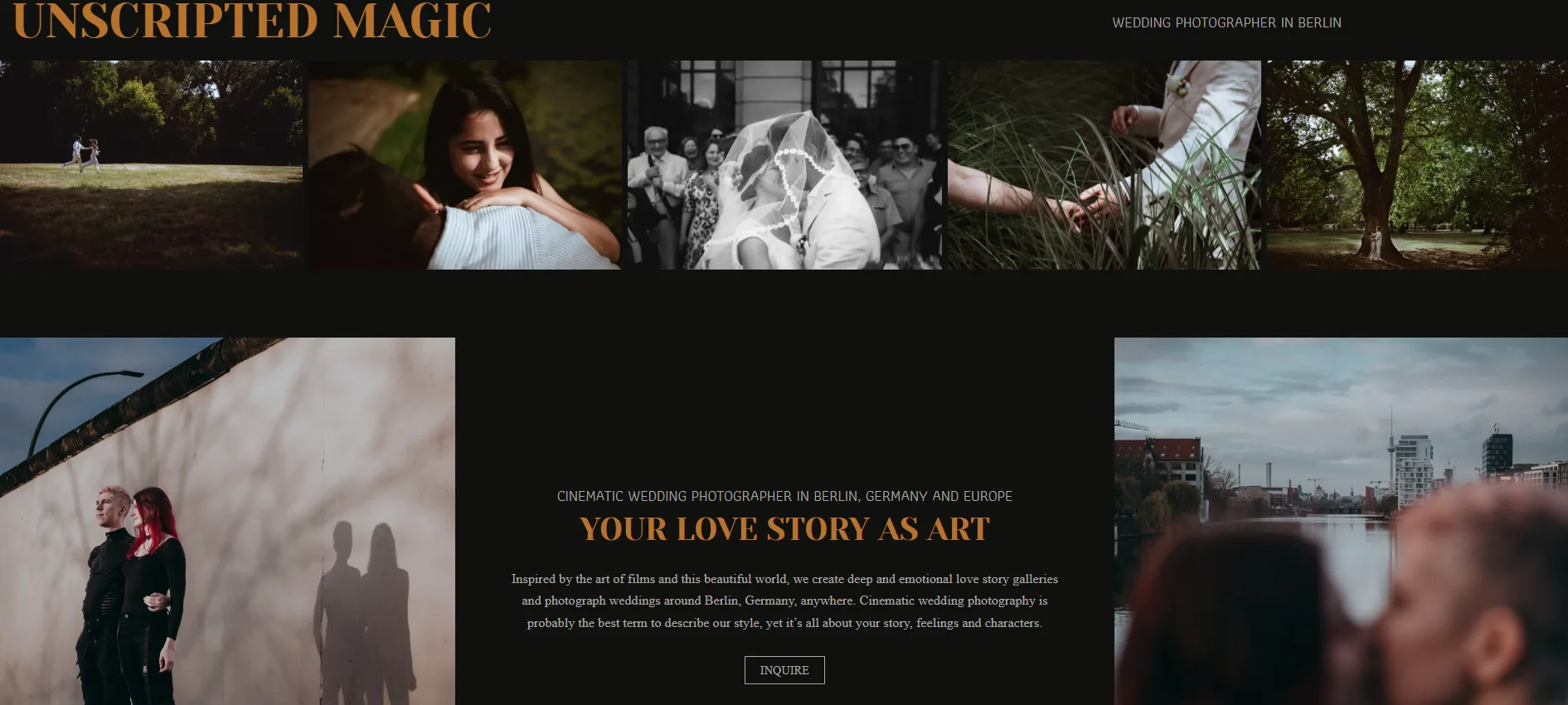
Design is something almost every photographer touches when starting out—you usually need a website, a logo, or an Instagram page. Right away, you’re selecting photographs or creating visuals that tell your story as a photographer. I’d recommend taking it a bit further, though. Even if you’re just creating for yourself, experimenting with design or graphic visuals is useful. Try things out, look at other websites and compare them to yours, see how different brands tell a story visually.
If you want some inspiration for the graphic design right now there are some cool works here (this is not affiliate and i’m not paid for any of the links here): https://www.awwwards.com/ . Most projects, sad but have to admit, look way more interesting and refined than the style of my site currently.
In addition to that this person is a designer and painter who has a lot of great materials that I recommend to people: https://www.youtube.com/@sinixdesign
Even if you’re a hobby photographer and don’t have a website, you can still play with design elements in your older photographs. You don’t need new photos. A little like collage art with paper, you can experiment digitally Photoshop is great for this or any software you like. Try adding geometric shapes, but pay attention to their value, colour, and hue. Think about how they work with your composition.
You can also print your photos and paint or draw on them. That’s still graphic design, because you’re exploring how to create a composition on a 2D surface with shapes, colours, and textures. Another step is turning it into a mixed media project, where photography is just one part of what you do. Shifting away from a single genre like this, is really like opening a window and letting in fresh air into your work.
- Experiment with layout, typography, and composition with your existing photos.
- Combine graphic elements with images to explore visual storytelling.
- Consider photography as one medium in a larger visual project.
Skills you train:
- Visual storytelling
- Layout and graphic design
- Composition in 2D space
- Colour Theory
Photozines and Photo Books
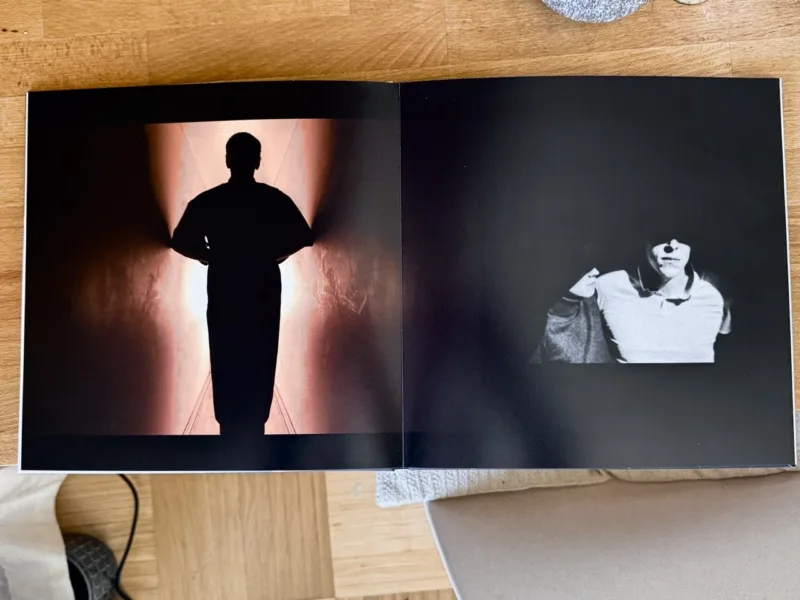
Basically, you can create photozines, which you can even bind yourself. It’s a simple way to take a number of your photographs and turn them into a small project where you select images, potentially edit them again, work with design, maybe add collage elements, and so on. It becomes a mixture of several things together. You could even include your 3D models there if you want.
If you focus only on photography, then the task is already meaningful—you still need to select the best-fitting photographs and arrange them into a project. But if you want to write something in the book, then you start working with text as well. And once you add text, you also have to think about how it sits on the page. It could be placed on a completely blank page—minimalism works very well—but it could also sit inside a rectangular shape, maybe slightly tilted depending on the style of your photography. It could be fluid, or half-transparent, or combined with lines or patterns that are slightly faded so the text remains readable.
At that point, the photozine becomes a combination of design and photography. Or it could include design, photography, painting, collage art, and even 3D modeling—almost everything mentioned earlier.
If you want to go further, and you have enough material, you can create a photobook. Usually it helps to think of the photobook as a project in itself, and mostly as a design project built around photography. Not just placing pictures there for memory—which is completely fine, of course—but if the goal is to move forward creatively and avoid a plateau, then the whole book needs to be considered as a structured visual piece.
When you approach it this way, you start thinking about how the book reads visually. You don’t place too many photographs on one page unless there’s a reason for it. Sometimes you even create a composition that flows through the whole book, where different blocks support each other and build a rhythm or a composition of the book with it’s own contrast and focal points and a colour palette.
Try it out!
- Select images carefully and consider the flow across pages.
- Experiment with minimalism, crowded pages, mixed media, or handwritten text.
- This teaches narrative, pacing, and composition across multiple spreads, much like building scenes in photography.
- Clear or messy style or both in contrast together.
Skills you gonna train:
- Project-based thinking
- Narrative sequencing in visual storytelling
- Multi-medium integration
Fictional Books: Imagining Scenes Visually
We’re used to a very fast-paced environment now, with lots of video and very direct visual media around us all the time. But when you pick up a good book: as you read, your mind starts to draw the scenes for you. You begin to visualise what is happening while moving through the pages.
You can even turn this into a small experiment. As you imagine a scene from a book, try to visualise it through one of the mediums we talked about earlier. You don’t need to spend much time on it. The idea is simply to deepen your visual literacy—to think about questions like: how would I set up the composition of this scene if I had to show it visually? Would I paint it? Build it in 3D? Photograph it?
This kind of thinking gradually puts you into a decision-making state that carries over into photography itself. You begin approaching images more thoughtfully, even when working quickly.
As long as you think of yourself as an artist and photography is your medium, you stay relatively borderless in how you develop. You don’t reach a ceiling where progress suddenly stops and the work starts feeling repetitive or stagnant. Instead, you keep expanding the way you see and interpret images
- Visualise scenes described in text.
- Try painting, photographing, or 3D modeling these imagined environments.
- This strengthens visual literacy, composition, and the ability to translate imagination into visual art.
Skills trained:
- Scene visualisation
- Creative decision-making
- Translating narrative into visual form
Conclusion: Exploration Helps your Style To Be Unique
Basically, there are many more things within visual arts that you can explore, and all of them can later influence your photography. Even something like designing or modelling clothes can become part of the process. If you create an outfit, you can use it directly for a photo shoot or build a whole photo project around it.
Important bit: if you go for any of the mentioned mediums try to forget about photography for a moment and fully enjoy these, we all may sometimes just need some rest from an activity we have been doing for a long time.
When you feel like you’ve hit a plateau or started getting bored, what you usually need is influence from somewhere else. Very often photographers mainly look at other photographers’ work, and when you stay inside just one medium for too long, the same decisions and the same trends begin to repeat themselves. Gradually, everything becomes a bit stiff, and you may notice that you start producing similar work again and again because you keep being influenced by the same sources.
Another important thing to remember is that photography itself already includes more than just using a camera at the right angle at the right time. Very often, you still have to set and shape the scene—working with location, light, styling, objects, colours, and composition. In many cases, the photographer is not only documenting what already exists, but actively designing what will appear in the frame.
The same applies to design and painting. In all of these mediums, you are making decisions about shapes, colour, balance, contrast, and structure.
That’s why it’s important to regularly look for inspiration outside photography. If you want your style to become truly personal, it almost feels like the only way forward. Whether you want it or not, we are always influenced by what we see. And the longer you look at someone else’s photography, the more your work starts to resemble it. This is not a bad thing at all—you can learn a lot from other photographers and apply what they discovered to your own work.
But at some point, if you really want to develop a photographic style that feels genuinely yours, inspiration needs to come from wider places. Reading fiction, learning about history, exploring different forms of art—or even learning something completely unrelated—will shape the way you see images. Visual style itself often grows strongest from visual mediums, which is why I recommend them the most, but in reality almost anything you learn influences the way you photograph.
Wish you to not get bored and stay creative!